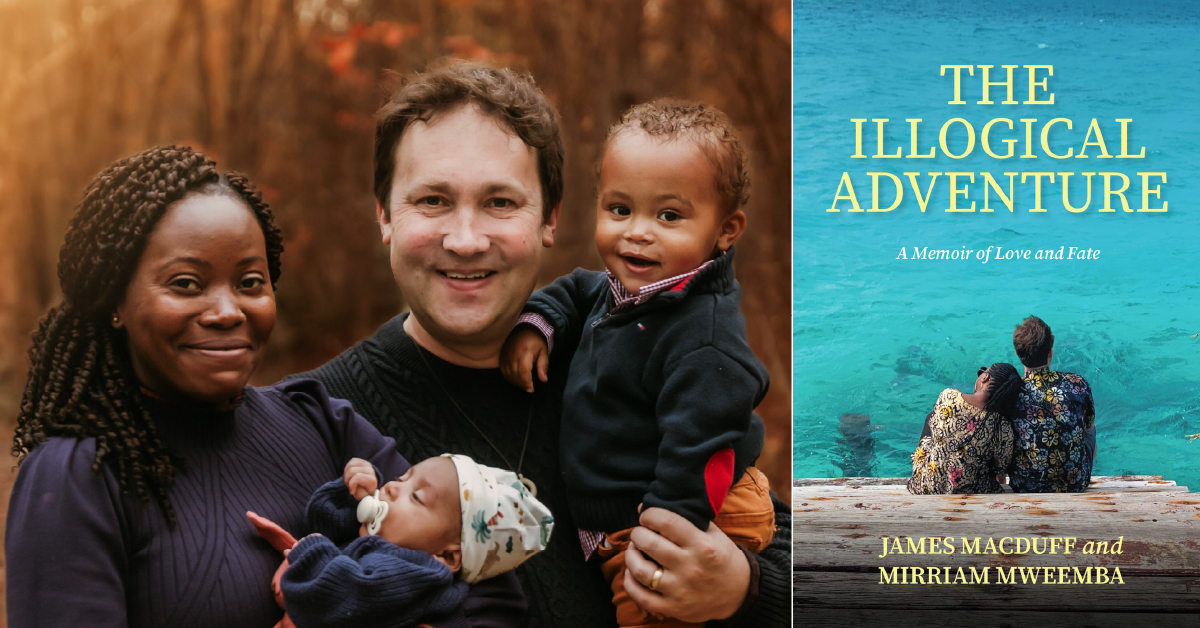
In this podcast episode, Rebecca speaks with Halifax lawyer, lifelong traveler, and memoir author James McDuff about the extraordinary love story at the heart of The Illogical Adventure: A Memoir of Love and Fate, which he co‑wrote with his wife, Mirriam Mweeba. James recounts how a chance encounter in Cape Town at the end of an ambitious voyage led to a long‑distance relationship shaped by travel, cultural exchange, and timing, and how the COVID‑19 pandemic—rather than pulling them apart—accelerated their commitment. Through stories of meeting Mirriam’s family in Zambia, navigating lockdowns, proposing abroad, marrying during a global crisis, and eventually building a family in Canada, the episode explores how a single, illogical decision can quietly redirect an entire life.
My review of The Illogical Adventure.
Support the podcast by purchasing the book using one of the affiliate links below.

Support my Podcasts using Patreon. Your $3 per month helps the podcast stay live, supports me as an Artist, and helps me access other funding.
Episode Transcript
Rebecca:
Why would an adventuresome lawyer leave Halifax and fly halfway around the world during COVID? Where’s the logic in that?
Welcome to definitely not Famous. More extra than ordinary. I’m Rebecca Hogue, your show host. In this podcast, I seek out memoir authors who are not celebrities, at least not yet, and interview them about their books. I share stories that are more extra than ordinary.
My Guest today is James McDuff Halifax Lawyer, Maritimer, and Lifelong Traveler. He with his wife, Mirriam Mweeba, are the authors of the Illogical Adventure, a memoir of love and fate. James sets the stage for our conversation outlining his maritime roots, the way he sought adventure, and how his adventures became the backdrop for meeting Mirriam and eventually building a family while still making room for travel.
James:
My name’s James McDuff. I am, uh. What, 47-year-old lawyer work in Halifax? I am AM a Maritimer. I was born here, grew up in Moncton, went to Queens for my undergraduate in Ontario, and quickly realized that, uh. You know, I wanted to be back in the maritime, so I went to law school at Dal and I, I work here in Halifax at McInnes Cooper.
Probably one thing that most folks would say about me is that I love to travel and I have had, since I’d say maybe my early twenties, a, a strong addiction to getting out on the road and, and have been able to, and somehow manage a, you know, have a career, a professional career, while also, um. Using it as a springboard in between hearings to travel to all the continents of the world and over 60 countries.
And so, uh. That is a passion of mine that continues on. Now my wife, also a fellow traveler, and we met in, in Cape Town on the road and and now are building our life here with two young toddlers and continuing to pack them along and teach them the love of travel as well.
Rebecca:
James’ life was full of more extra than ordinary adventure. This illogical adventure begins far from home after an ambitious trip that ends in Cape Town, South Africa. James tells the full cinematic how we met story, the long voyage that brought him to South Africa, the last night in town, decision to linger a little longer, and the moment he noticed Mirriam sitting alone and decided to take a chance.
He also gives us a glimpse of Mirriam’s view of that first meeting, why she was there, what she thought she was seeing, and how a brief conversation turned into a connection strong enough to survive the distance.
James:
Well, the prologue of the book is the opening meeting in Cape Town. I always laugh because when I tell the story to folks about how Mirriam and I met, I have to start by saying, in February of 2018, I took a tall ship, sailing cruise from the south of Argentina to Antarctica.
And people say, well, I thought you were talking about how you met your wife. Like what is this story about a tall ship going Antarctica? So I had been. Planning this trip for quite some time and trying to figure out how I could take a few months off work and the day came in 2018. I was intrigued by this trip for a whole bunch of reasons with the sailing and the tall ship and the chance to get to Antarctica, but it was also a transatlantic cruise, so it left from the south, south of Argentina, Patagonia area where I had never traveled, and it arrived in Cape Town in South Africa, also a country I’d never.
Visited before, and so it hit a whole bunch of different boxes for me to, to go on this trip. So I went on this 50 day sale, had a lot of time to think about the future and all, and my career and what, what I wanted to be doing. I was just turning forties. All those midlife thoughts come into mind. And we docked in Cape Town and I had planned to spend one week in Cape Town before flying back home through Dubai and then London, and then home to Halifax and so on the last night.
That I was in Cape Town. I went to a pub to watch my favorite team Arsenal play. They, they were playing against their hated rival, Manchester United. We were. A last minute goal by the other team left me. I was planning on going out for a walk and just enjoying the night, but a last minute goal by the other team left a sour taste in my mind.
I had stuck around for another beer and was chatting to a local guy, and over in the corner there was this beautiful woman sitting by herself out of place in the sports bar, and I thought. You know, I should, I’m only here like one more night. Sometimes you always have those questions of, should I go over and say something?
What would you say? Hey, or other things like that. And for some reason I ended up going over and asking if I could sit down and, and when from Mirriam’s side of the story, I had this gigantic caveman ask beard at the. I had shaved for like five months and my hair was scraggly and you know, so I would’ve been quite the, quite the thing to look at in terms of probably she wouldn’t, she saw me, she didn’t expect, oh well this is my future husband coming over now.
She was on the other, she worried about the poor Canadian white guy over there who may be talking with some locals. He shouldn’t be talking to because he might get, he might get, they might have designs on taking his wallet or doing something. So she was looking out for me in a more caring way than I, than I had in my mind at the time.
But when I sat down with her, and the only reason she was there was because her taxi driver, who she used was late. And so she just, she’d never really been in that bar before. She didn’t know why she went in, she was there. And so she was waiting for her, her driver. And as we got to talking. We thought, okay, you know, maybe we should go to a different spot.
If your driver’s coming and you know, the Cape Town, I’m just here as the, as a tourist, we could go to a different spot. And she had a, a place in mind this neat little restaurant slash slash bar that, that we went to. And that that point I got a chance to really talk to her a little bit more and tell her about how I had got to Cape Town and on my phone I had all these videos of penguins and whales.
Big seas and icebergs and things like that. At that point, I think she became a little bit more, who is this person who wasn’t expecting any of this? And, and we really just hit it off and, you know, to the point where we exchanged contact information and, and said she was getting ready to go work in Europe on a cruise ship.
I was going back home to Canada to get back to my life as a lawyer and continue to think about. But I still had the idea of traveling and thinking, well, I, I’ll be in Europe probably, and not too long maybe we could meet up and see, see what happens. But, but yeah, I, at, at that point, whether or not we would ever meet again was highly questionable.
But, but the sparks were there from the beginning.
Rebecca:
When the pandemic arrived, it rewrote everyone’s plans. But for James and Mirriam, it also accelerated a decision that they couldn’t postpone forever. James walks through the chain reaction, COVID set off in their long distance relationship, a canceled reunion, months of uncertainty, and then a bold decision to meet anyway when a narrow travel window appeared.
He describes the mixture of fear and commitment that carried them through restrictions in quarantines. How the unusual season created space for deeper time together leading to a proposal, a wedding in Zambia, and the complicated next step of navigating immigration so they could build a life in Canada.
James:
It’s strange to think about how COVID was such a devastating impact on, on relationships and, and families keeping people apart, keeping people locked down. And for us it was, it was the opposite or it, it ended up having the opposite impact. At first, we were planning to meet. So we had met a number of times through, so we’d met the first time in April, 2018.
We ended up meeting in Europe a few times. We met in Africa once, and I was planning on, and I had gone to visit Mirriam in Zambia. And so we were planning on meeting in Johannesburg in March of 2020. At that point, I think we were start talking more seriously about what do we have here and are we gonna make some changes to our, to one another’s lives to accommodate some type of relationship that’s more than just a long distance sea and every few months.
But of course, as the, as we were getting ready, I think our flight was like March 25th or something like that, a week. Before, a week after everything ended up shutting down. So that trip was obviously canceled. I went home, my parents live in Moncton. I was just have a, at a condo, like one bedroom, you could see the writing on the wall that this wasn’t going to gonna end any time soon.
So rather than live alone for that time period, I thought I would travel home and spend the time with my, with my parents. And I was lucky that I got across the border before even the New Brunswick Nova Scotia border closed. And so Mirriam was, was in Zambia. And, uh. We spent a lot of time thinking about how are we gonna meet now?
When is this gonna end and what, what, what’s that going to look like? And we started, we chatted a lot on the phone and she had a chance to kind of video calls with my parents. She hadn’t been to Canada by at that point yet. And so we were talking about all these things and then we, in my searching of what to do and, and how things might work, we found that KLM was flying flights to Tanzania.
Ethiopian Airlines was flying flights to Tanzania in the summer, starting in July of 2020. And so we looked into it and thought, are we crazy? Is this, should we do this? Is it safe? We started reading all about all of the, the risks for each other and will this, what would we do if we got there and are the places opening?
And, and Tanzania is one of the few countries that, for tourism reasons and other reasons of skepticism among people in their government. They thought were going to be on the front end of allowing people and the flights were available. So we thought, let’s take this chance. But we didn’t share very widely.
We sh we told our families that we were going and, and they shared their concerns and asked how we were gonna protect ourselves, what were our contingency plans, everything. And there was a part of me that thought the flight is never even gonna go ahead, just get canceled. So it was kind of a dream that you get on this plane.
It was mostly empty fly to Toronto, and then the airport was empty, and then you fly to to Amsterdam and then down and Mirriam’s went, took her through Ethiopian Airlines and she had the same conversations with her brothers who were taking to the airport. Are, I don’t, they’re, we’re some working in the government.
No one is traveling. What are you doing? Is just important. Like, but they could see that we were keen on doing it. And, and they, they trusted us and I was working as everyone was from their computers at home. So I thought, well, I’ll just work from my computer on the wifi and the hotels, and I don’t have to tell anybody.
Everybody just assumes you’re where you are. So, so that’s what we did. And, and the flights went off without a hitch. We spent most of the time just on our own, like when we got to the hotels and things, there wasn’t a lot of interaction, but some of the places. They were just reopening. So the tourism industry, the hotels, the tour guides, other things that we were doing we’re so happy to have people coming back again.
And so we were doing all the precautions. We had to do the COVID tests, and then of course when we returned home, we had to do the, the quarantine for two weeks at home. And so we, we followed all of those. Protocols and, but it enabled us other times when we would meet, we could maybe meet two weeks at a time, ’cause I’d have to be back for work or something like that, or Mirriam would have other obligations.
But with COVID we didn’t have those. And it gave people the opportunity to work remotely in a way we’d never had before. So after the success of the. Trip in Zanzibar where I ultimately ended up proposing as part of that trip again, to kinda say, let’s, we’ll figure this out now that we’ve managed this kind of miracle.
But then to go back and, and then start thinking when will the wedding take place and what will that look like? And then how can Mirriam get to Canada with all of the immigration restrictions, just particularly foreign African. But in the time of COVID, no one was coming at all, so we had to try to figure out how to.
How to manage that. And so we, we decided to get, Zambia wasn’t open in July, but they were opening in November. So we went back in November. I went back in November and we organized the wedding among the. It’s a small wedding with Mirriam’s family in Zambia and a honeymoon in Zambia, where Livingston is a great place with drafts and elephants at the honeymoon.
And so, and then of course I returned home with all the documentation to try to start the permanent residency process for Mirriam and during quarantine again. So it was a lot of travel and concern and, and joy and fun about, you know, having been able to pull off these trips and then the relief of getting home.
Safely and, and just relaxing and being out of touch with the world for to the two weeks that you have to just live in your own, in your own space. And there was an element of those. Just decompressing after, after traveling around the world in a stressful time that I also ended up coming to enjoy as well.
But all of the time working and being able to, to do that with the support of colleagues and clients who became aware of what was going on and the started to, you know, bearing more broadly as the world was slowly opening up that these were the trips that I was doing and, and so it all, it all managed to work itself out.
Miraculously,
Rebecca:
a relationship becomes real in a new way when you step into each other’s families and into the cultural expectations that come with them. James shares what it was like to travel to Zambia and meet Mirriam’s relatives. Moving from the tourist friendly world of Victoria falls towards the place where she grew up.
He describes the warmth of the welcome, the small moments of navigating language and unfamiliar routines, and why the visit demonstrated the depth of their relationship. He shares the context of Mirriam’s family, how she had long prioritized travel and career over the pressure to settle down and have a family.
So bringing a partner home signaled to everyone that this time was different.
James:
When I made the trip to Zambia at the end of 2019, we didn’t necessarily have a plan either way. We’d never really talked about whether or not we would go and whether it would be just a trip of the two of us and the Livingston, where the Victoria falls are and the Zambia River.
A, an excellent tourist destination for a backpacker to a city to wanna visit and then that we would have the chance to stay. But it, I think in the back of both of our minds, we knew that it was only a few hours to where Mirriam grew up, where her mom and some of her sisters are, and then her in the capital city, her brothers.
So she comes from a, a large family. So we knew that that possibility was there, but we weren’t either of us. Kind of pushing it. But after a few days in being in Zambia and kind of reconnecting again as we hadn’t seen each other since a previous trip a few months earlier in Europe and, and seeing like, yeah, this is the kind of bond that you know is more than just a travel fling or something.
Let’s see where it might go and. I believe that it, I mentioned to Mirriam at one point I’d be open to going if you, if, and seeing where you grew up and seeing your family if you wanted to do that. And she, I could see that she had been waiting for me to express that interest. She didn’t wanna. You know, put it on me to say that, but it was clearly on her mind as well.
So she was very happy to hear that. And then quickly we made the arrangements and it was a really nice welcome for me because Mirriam was the traveler among her group of brothers and sisters. She was the seventh of eight and, and also had some, some stepsisters and step stepbrothers as well. And so she, but she was the one who had, from an early age, decided to express an interest in traveling and had traveled and gone to Europe and everything else.
So, and she had never. She’d always put that aspect of her life first, a little bit against the cultural stereotype of you’re expected to get married at an earlier age and start your own family. And she avoided those pressures that she had to face from time to time in favor of focusing on her own career and her own, on her own issues.
So when she brought someone. From another culture home, it was already a sign of, wow, this must be something serious because she’s not prone to do this. So from my, I kind of realized this later. That I got this real like, joyful welcome and you know, wow, this is finally going, you know, this is, this is nice to see, and everything else.
So it was kind of a little kids coming, running around and it was, it’s like a bit of a farm type atmosphere there. So there were cows and chickens and things, kind of the rural environment. So it really was a nice. It was a nice moment to see, you know, the language gap was a little bit, they speak English in Zambia, but also like local Tongan is the language in Mirriams village of Otoka.
So we were kind of navigating that and just a little bit of the kind of looking on both sides, who is what’s going on? But it really kind of cemented. You know the idea that by the end of that trip and then we subsequently traveled through to the Capitol and met up with a few of Mirriam’s other siblings and had dinner with them and had a real chance by the end of it, that was clear to me that we would have to continue.
And start trying to figure out ways where we could spend more time with each other rather than only a few weeks here and there on the rest of the time being on the other side of the world. So that’s kind of what sparked our discussion. Okay. When’s the next time in March and Johannesburg. And then we’ll.
See what we can do. Then little did we know that COVID would happen and then as I say, the the steps kind of worked themselves out from there.
Rebecca:
Figuring out a title is often one of the biggest challenges an author faces. James shares how a reading assignment led him to align about how love is an illogical adventure and why that phrase captured the heart of their memoir. He connects the title to the book’s central theme. A chance meeting can redirect an entire future, new country’s new commitments, and an unexpected family far out of proportion with a small moment that started it.
James:
I give credit to the King’s MFA because we had an assignment, I think Dean Jobs said, give a list of the top 10 nonfiction books or something that you, but it’s an assignment that makes you think about what are your favorite nonfiction books and do a little bit of a. Kind of, I don’t know if it was a one page or a half page summary of each, just to get you thinking about those things.
I always love those assignments because they were never too onerous in terms of the amount of work, but they, they really did make you think and, and they were enjoyable because you’re thinking about, okay, well, which books did really move me at different times in my life. And one of them was, travels with a Donkey in Spain by Robert Louis Stevens.
And as part of the assignment, I thought, I haven’t read that for so long. I’m gonna go back and read that again. And I did. And to the point where I was like, wow, this guy’s great. I always loved Treasure Island as a kid, and Robert Louis Stevenson, when I later found out he had did this other writing, that was good too.
After reading the travels with the donkey again, I looked into some of his other nonfiction work that he had written, and I came across this essay that he’d written called On Falling in Love. And at this time I was far enough along that I knew where the story was. I knew it was gonna be this Mirriam and I meeting, and then the story of ourselves and then and concluding after we Mirriam’s come to Canada.
I knew it was a love story, but I was desperate to try to figure out a title. And titles are so difficult. Um, and in this, in this essay, there was a, there’s the quote, falling in love is the one illogical adventure. And I don’t remember all, I should have the quote memorized, but I don’t. But it’s something about it being the one thing that’s in this trite and reasonable world that’s supernatural.
And I just looked at that and I thought, oh, that could be it. ’cause adventure. There’s a lot of fate involved, theological aspect of it like that is great. Then I had to think, okay, Google. Who else has uses title? And I was overjoyed to find out that I couldn’t find any other book called Theological Adventure, and at that point I thought.
Yeah, this is the number one candidate. We hadn’t decided on it, but it was really that the more we talked about it and I talked about it with Mirriam and we tested it, we didn’t ever really have a strong contender against it because other thing about across the ocean or like it was all it, not, nothing really fit that neatly.
And we had this beautiful epigraph like to open the book as well and it really communicates, I think the. Um, the nature of it, which to us is travel has been an adventure, and this is kind of the greatest adventure of our travels, was meeting each other and had such a, the. The other aspect of the quote is about how the, the effect of falling in love is so out of proportion with the, with the cause.
Like you fall in love and then everything in your life changes and goes in a certain direction that none of it would happen. Like would I have ever visited Zambia in my life? Would I have ever. Gotten married, would I have had children without meeting Mirriam? I had not up to that point, and I wasn’t, it wasn’t something that I was banking on doing, but so you have a whole nother life now that is because of this one chance meeting that if our paths didn’t cross, then unlikely they would’ve somewhere else.
So. What, what would’ve happened for either of us? Who knows?
Rebecca:
Thank you, James, for taking the time to talk with me. I’m sure listeners will agree, James and Mirriam’s illogical Adventure is more extra than ordinary. Stay tuned on the next episode of Definitely Not Famous. I’ll continue my conversation with James. We’ll talk more about writing Craft and how he was able to co-author the book with Mirriam.
You can support James and Mirriam and this podcast by purchasing their book using the affiliate links in the show notes.
Thanks for listening to, definitely Not Famous. More extra than ordinary. This podcast is brought to you by me, Rebecca j Hogue, the host and the producer. To support the show, please consider becoming a patron of my art using the Patreon link in the show notes. Alternatively, you can purchase the books using the affiliate links also located in the show notes.
You can learn more about the podcast on the website. Definitely not famous.com.
Leave a Reply