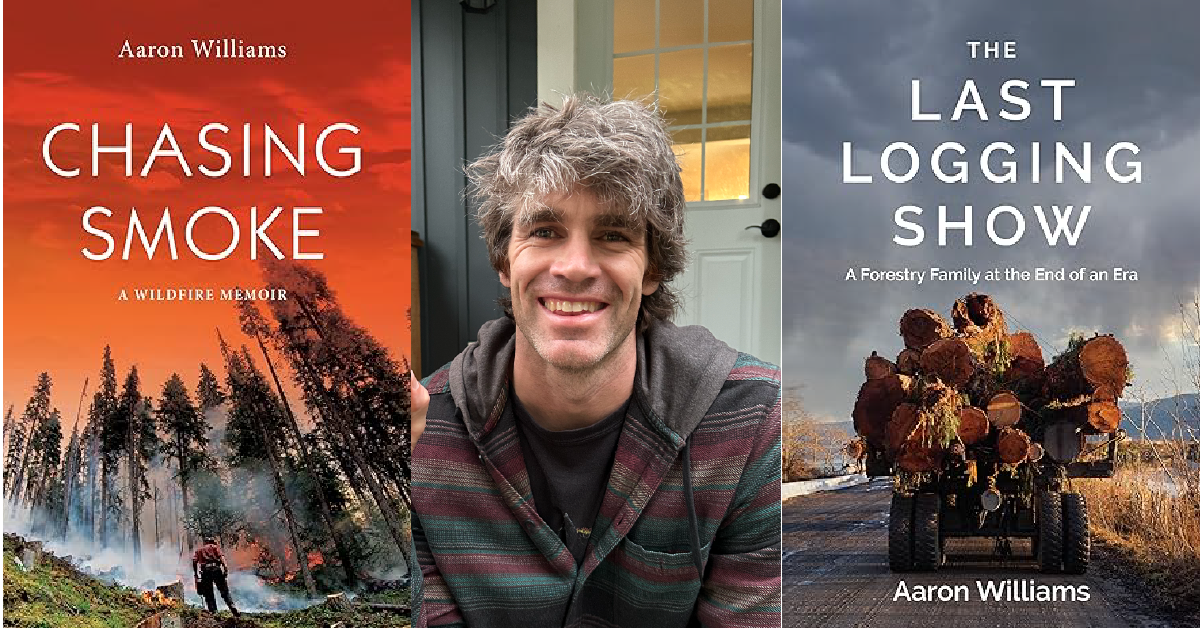
In this episode of Definitely Not Famous, host Rebecca Hogue speaks with Aaron Williams about his memoirs Chasing Smoke, which recounts his work as a wildland firefighter, and The Last Logging Show, which follows his family’s history in the old-growth logging industry in northern British Columbia. Aaron discusses his upbringing in Terrace and Haida Gwaii, how logging camps shaped his understanding of the bush, and how his logging background helped him move into firefighting after the Queen of the North sank and altered his plans.
He explains the practical side of wildland firefighting, including building firebreaks, cutting hose trails, and clearing land to mineral soil, and says the work pushed him toward greater discipline and teamwork. Aaron also reflects on writing *The Last Logging Show* while his first book was being published, his goal of documenting a disappearing way of life, and his choice to include environmental and Indigenous perspectives after feedback from early readers.
The episode closes with Aaron discussing his current manuscript about the Martin Mars water bomber and the lessons he has learned from publishing, including the value of reading widely, working well with publishers, and being easy to work with.
Support the podcast by purchasing The Last Logging Show using one of the affiliate links below.
Support the podcast by purchasing Chasing Smoke using one of the affiliate links below.

Support my Podcasts using Patreon. Your $3 per month helps the podcast stay live, supports me as an Artist, and helps me access other funding.
Transcript
He grew up spending time in the logging camps in Haida Gwaii, at the time known as Queen Charlotte Islands. Through a series of unexpected shifts, he started fighting wildfires. How could logging possibly prepare Aaron for fighting fires?
My guest today is Aaron Williams, the more extra than ordinary author of two memoirs, Chasing Smoke, about his time as a wildland firefighter, and The Last Logging Show, about his family’s experience as one of the last old-growth loggers. He grew up in a small town in northern British Columbia, Terrace, only 60 kilometers from where I grew up.
After the Queen of the North ferry sinks, an unexpected, to say the least, event that had far-reaching effects in northern BC, Aaron had to make a pivot and signed up to be a wildland firefighter.
Coming from a family where my my dad was a logger when I was a kid, then he was, running a concrete business for a while through my, younger years into my teens. Then he went back to logging when I was a teenager, at the very impressionable age of as far as working goes, at like around age 16, when you’re thinking like, “Eventually I’ll have to work,” and that’s what Dad did for most of his life.
But as far as how that led to firefighting, … It was, a connection that we had in the interior of BC in Smithers that their son had gone into forest firefighting and, it was like well-paid, better paid than the kinda jobs that were around on the coast at the time.
the economy like in Prince Rupert was pretty bad around 2000, 2005, 2006. So it was like, this is, yeah, it’s this is like well-paid work that you don’t need like a ton of education to do. It’s in the bush. You’re familiar with that because I’d been working with my dad logging in, later in high school in the summers and then after high school for a bit.
So that’s the list of ingredients or the way that it led to… But that’s how I got to firefighting, And then I also should add that I was working on BC Ferries in the summer of 2005, cleaning the boat when it came into Prince Rupert. This was the ferry that ran from Port Hardy on Vancouver Island up to Prince Rupert on the north coast.
And I would clean that boat every second night when it came in to Prince Rupert, vacuuming and, wiping tables and listening to my Discman overnight. And, the plan was to become a deckhand on the boat the next summer. So during that winter, I took my courses. It was like a month’s worth of courses to become a deckhand.
Basically a week or two after I took those courses, the Queen of the North sank, and they were down a ferry. They weren’t hiring any deckhands because even though they were stretched to the max with the ferry they did still have, they didn’t need a bunch of extra new employees. So between that the ferry sinking, and my mom’s connection to our friend in the interior, whose son was firefighting, it was those things came together and it was like, this is the next logical step.
Nothing seemed like it was logical at the time.
Being a wildland firefighter changed Aaron’s life trajectory, helping him get out of a listless teenager funk. Peer pressure helped him learn to take his job more seriously.
The change kinda came slowly. I feel like I’m really slow to adapt to anything. And, so the first couple years of firefighting, I was resistant to this kind of like fall in line, put the team before yourself kind of mentality.
And then f- for whatever reason, I just kinda came around to it. I guess it was just like basic peer pressure. It was like I had friends on the crew who, were maybe a little bit more willing to fall in line, some of them, and and be, just be a little bit more, tuck in your shirt, tie up your shoes, we need to be presentable to the public, that kind of stuff.
at first I was hesitant to like, to take on all of those seemingly like stuff that I always looked down on, who cares what you look like, it’s what matters inside kind of thing. And then making those changes of no, it does matter like how you’re perceived by the public if you’re in this sort of public-facing position and stuff like that.
So I guess it, overall, the change was one from like less discipline. I almost feel like if I connected it back to high school, my high school was quite regimented ’cause it was like I was in band, I was in sports, I was like really busy all the time, and never really felt like I had enough freedom, in quotes, to do what I wanted.
I often found myself like wanting to be able to ride my bike more or go skiing more, but it was always, there was always basketball or band got in the way of that. So then I finished high school, and I suddenly I had a, I felt like I had all this freedom, and I was really enjoying that, and then I get into firefighting and enjoying that, but also there was this listlessness to it as well that s- that sort of started to take hold into my early 20s.
And firefighting snapped me out of that, eventually. So definitely my first few seasons on the crew, I wasn’t like, I wasn’t somebody that I think other… Say we came across another fire crew, they wouldn’t have looked at me and been like, “Ooh, that guy’s good. Like we could– I sure wish we had him on our crew.”
It was like I was not a model worker. But I, tried. Like later on I started trying.
First logging, then wildland firefighting. There must have been some skills that were transferable. Both loggers and wildland firefighters spend a lot of time living in camps in the middle of nowhere. Aaron developed some skills in his childhood, like using a chainsaw, that helped him on the fire crew. He was comfortable working with loggers and the professional bulldozers and excavators. Knowing the language of logging helped him when he was leading a fire crew.
I think it was just like an overall comfort of being like out in the bush far from civilization. I definitely was very familiar with power saws, which was like a big help on the fire crew or like a big sort of leg up. I still remember the first time I picked up a chainsaw.
It was in my, I think my first or second year on the fire crew. I didn’t really know anybody very well and a few logs needed to be cut and I was like, “Oh, I’ll just do it right now.” started the saw, cut ’em, and the, my crew boss at the time was like, “Oh you handle that thing like it’s a dinner fork,” I think he said.
And I was like, “Oh, thank you. That’s just like like I’ve been doing it since I was 10, so I know how to do this kind of stuff.” and then otherwise, I think the big thing is that the big connection between logging and forest firefighting is on, fire crews you spend a lot of time working around loggers who are digging in fire breaks with their bulldozers and their excavators and stuff.
And I feel like I really understood those people and that work in a way that quite a few we’d hire some kids out of universities and stuff and bigger centers that didn’t really have any experience working around, this demographic. And for me it was like, “Oh, I like, I know this guy.
This guy is just like my dad or just like my uncle or just all these guys I’ve, I grew up knowing.” so that was a big help I think, was just being able to like communicate with the sorts of people we’d encounter out on fires.
In wildland firefighting, it isn’t all about spraying water and attacking the actual fire. Aaron describes how it often also involves creating fire breaks, which require clearing land using techniques and tools that loggers also use.
A lot of it is like what you’d call indirect attack. It’s let’s set up way away from this big fire.
I don’t- my favorite part of firefighting is actually when you’re up close to it, and it actually feels like you’re in this, in a actual fight with the fire, where it’s like, “Okay, we can cut this hose trail really close to the fire, lay hose along the fire’s edge, and try to spray it out before it becomes a problem.”
Pretty often, though, , you’re building fire breaks further away, and what you’re doing is you’re taking out the trees, scraping everything down to what you call mineral soil, so that f- so that, the fire will, in theory, burn up to it and then not be able to burn across it. As you can imagine, if a fire crept up to a highway, it’s not gonna then burn the asphalt and the rocks right across.
Like it’s hit like a it’s hit a point where it can’t burn any fuel. it doesn’t usually work as well as hoped, I think. But, yeah, that’s a big part of it is like what you’d call indirect attack.
Aaron began work on his second book while his first book was still being published. He saw the ways the logging industry was changing and wanted to capture that way of life. It was also a great excuse to go visit BC and his family.
I’d actually started this last logging show before my wildfire book was published. It was a combination of I was writing it, like what I realized looking back was like a furious pace. I was just like, I didn’t really have much else going on in my life, and I was just using up every, like a lot of spare time or whatever just writing.
And so as soon as I was done that wildfire book, I think I was like, I already had in my head, I was like living in Halifax my partner Sue had a job out here that was the main reason we were living here at the time. I was– I definitely missed BC. It was, I, all my friends were there, a lot of them, and I’m very attached to the place and the work that I had been doing and stuff until recently.
And I also knew that my dad was nearing the end of his career, even though it turned out he had 10 more years left in him. But he was getting on in years, as were a lot of his coworkers. They were doing this really interesting type of logging on the coast, which you don’t see too much of anymore.
Like it was old growth logging, so they were using I guess it’s like challenging work and A lot of things are automated now, but a lot of the stuff that they were doing was still like going out, like boots on the hillside kind of thing, like cutting down trees with power saws and dragging out trees with like older equipment and stuff.
So that really fascinated me was like, “Oh, this is like a way of life that’s disappearing.” And so between the homesickness and the interest in in the work itself and how it was in its sunset years and also just just really being like passionate about writing as much as I could.
that’s what led me to the logging book was a combination of “Here’s something cool that I think is not gonna be around for much longer, and I miss BC and my family, so it’s a good excuse to go out there and spend time with them.”
Aaron explains how the type of logging his family did felt like pioneering. They would land at a beach and have to build everything from scratch, not knowing what challenges they would face along the way.
a lot of guys can remember exactly when they first arrived at a new place because it’s a very pioneering kind of thing. There’s nothing there. Okay, we have to establish a beachhead, It’s like we need a shop to, to be able to fix equipment.
We need a clearing where we can put the equipment, and then we start building a road, usually up a valley. And from there, like the very first trees that are cut down are basically right where the, right where they first land, and then from there they just work their way back. It’s you could really view that as a sort of really insidious like, destruction of nature.
it certainly is that, especially the way they used to do it. But from a h- from a sort of like a human industrious standpoint, it’s, it would be very exciting because, much the same as like how maybe a fisherman feels once, when they put out their nets or put out their traps, and it’s “What’s gonna happen?
are we gonna make this work? Is it gonna all, will the, are there fish here? Are there crab here or whatever?” It’s like with the logging, it’s “Here we are at this new place. Can we make this work? What kind of problems are we gonna run into?” it’s a pioneering kind of a endeavor that, that is like extremely rare these days, especially in the, in, in like more developed countries where we have lots of machinery, and we’ve been doing it for a while.
Aaron wrote his first book as part of an MFA program. It was based upon ex- the experiences he had in the past when he didn’t know that he was gonna be writing a book about it. That meant that he didn’t do the specific research and take detailed notes to help him in the writing process.
For his second book, he had more opportunity to do research. He worked more on writing craft.
I felt like with my firefighting book, I missed an opportunity to do a lot of research and incorporate that into the book. I felt like I had this great sort of, foundation or skeleton framework for a book with my firefighting book, which was that like I’m just following a fire crew through a season.
But I did basically no research, and that in hindsight, I was “Oh, missed an opportunity there.” that book could have felt a lot more well-rounded. It would have been more informative to people who know nothing about wildfire and stuff like that. So that was one thing that spurred me on with the second book was like, “Okay, do more research.”
And even then I did significantly more research. It still felt a little thin at times. And second book compared to first book this story was less about me, which I felt relieving. you saw like a lot of me in the first one and less of me in the second one, and the second one felt like a nicer balance.
I don’t think I’m as much of a straight, memoirist, here’s my story, as some other writers are, who I enjoy. So yeah, more research in the second book and just more care, overall. Writing my first book was like if you ran like a running race and you felt really good, like you’re like, “Yes, I’m running.
This is good. I’m working hard,” and you get to the end, and you realize you got last place. You’re “Oh, I felt like I worked hard, but there’s obviously a lot of people out there who have worked way harder, and if I wanna be good at this, I have to buckle down a bit more.” That’s what it felt like with the second book.
In The Last Logging Show, Aaron does a more extra than ordinary job of balancing the perspectives of the loggers with environmentalists and indigenous concerns.
To me, it didn’t feel like he was making any judgments, which made the book feel especially well-balanced. To achieve this balance, one of his strategies was to get feedback early on and listen to the feedback.
The few people that I showed it to that I didn’t know at all, they were very adamant, I think, that I had to introduce more sort of opposing viewpoints or who saw it from a different perspective, yeah, than my own. And so I took that seriously, I didn’t, I was like I do want this to be something that is not necessarily favoring any one side too much.” So I was like– So I, I just took it seriously. I was like, “Okay, t- to really, make an extra effort to think about, what about the, the people who really view this as, quite an awful thing that’s going on,” right?
I really didn’t wanna be painted with, like a pro, a super pro-logging, conservative viewpoint brush. I didn’t, I really didn’t want that, it didn’t seem… the best books that I read are, a similar kind of thing, where you’re just, you’re reading along and this person’s presenting stuff, and a lot’s left up to the reader.
I really like that. I don’t like really didactic, environmental writing, which I read a lot of for this book. like Elizabeth May has, a memoir of, her time in the on Haida Gwaii and stuff like that, and it’s it’s good, but it’s, Elizabeth May, so it’s obviously gonna be, like, very Green Party.
And then there’s also, from the other side, there’s, very sort of conservative viewpoint stuff that I read where it’s just “We should log all the trees and because it’s, because then when we make them into plantations, there’ll be higher production,” we’ll get more… So it’s like I, I can’t stand that stuff either, so it’s okay, how do I go down the middle there a little bit?
I’m always curious to hear how the titles for books come to be. In this case, I got to learn new terminology, specifically the way loggers call the projects that they’re working on shows. Aaron explains how the titles of his two books come to be.
I didn’t really have a title for the firefighting book. I had some not great titles. Harbour Publishing, at the time, there was a popular book by Charlotte Gill called Eating Dirt about, it was a tree planting memoir. And Harbour wasn’t, was thought maybe the title either Smoke Eater or Eating Smoke would be a good title, which I didn’t really like just because it wasn’t really a term used in firefighting.
So my friend, I asked my good friend Sue Pierce who’s still in wildfire, she just texted like 12 titles, like just jokingly offhand, like she’s very funny and, very bright. And, one of them was Chasing Smoke, and I was like, “Hey, that sounds good. Let’s go with that.” and thankfully Harbour was, was into it.
So that’s how that one came about. And then The Last Logging Show, I always liked the title of The Last Picture Show, the Larry McMurtry book. He wrote Lonesome Dove and other sort of, literary type Westerns. Anyway, I loved the title of The Last Picture Show, even though I’d never read the book.
And I just thought lo- like people very often areas that were being logged by a company were called logging shows. “Oh, he’s working on a show out in Campbell River,” or “He’s he was on a show up on the mid-coast” or whatever. So lo- logging show, and ’cause it was the last one, I was like, “Hey, that’s, that, that works all right, The Last Logging Show.”
After that, after seeing that, there’s a lot of books with the title The Last something or other which is always the case, you’re never as original as you hope you would be.
With his second book published, I wanted to know what Aaron had planned for his third book. He was lucky that Harbour Publishing reached out to him to work with someone to write a book about a water bomber plane used in wildland firefighting. He reflects on both the great opportunity and challenge of writing for a project that wasn’t his from the start.
I’ve almost done a short manuscript about the Martin Mars water bomber, which was stationed in Vancouver for a lot of years. It’s like a World War II era flying boat big giant seaplane. And, it was a, an iconic plane, especially in BC, and especially on the coast of BC. And so after I finished the logging book, Harbour Publishing got in touch and said, “Hey, this, fellow who used to work on these planes wants to write a book about it.
Would you co-author it with him or ghostwrite it or however it however it crunches out?” And, that was perfect because I was tired. I didn’t have any ideas. We just had a third kid, and, this was a great way to keep, keep working, but not have to go through the legwork of coming up with a topic or putting in a proposal or anything like that.
Having said that, as I get closer to the end, I’m at about almost 40,000 words. I think the finished product will only be about 40,000 words, so not a long manuscript, but a bit of work. and now that I’m close to the end, I’m feeling like, okay, I’m ready to go back to a topic that, that s- that was, mine from the beginning.
it’s my first experience of a work for hire kind of thing, and it’s been great. But it’s also it’s also like it, it can be hard to maintain like a level of serious investment in it over a longer period because it didn’t– ’cause it’s weirdly just because it’s not my own thing from the start, if that makes sense.
Aaron’s publishing experience and his work in a local indie bookstore had shown him the importance of appreciating his publisher and doing what he can to be someone easy to work with. He also advised new writers to read a lot in your genre. Even if you don’t intend to quote it in the book, the background knowledge helps round out your story.
That there’s very little money in it unless you’re at the very top of the pyramid. That you s- that publishers are extremely busy and, stretched thin and the less of a, the less don’t be a thorn in their side. Just like as much as you can, be agreeable, put aside your ego and cooperate.
I have like– I feel like something that’s really im- given me more perspective on the publishing world actually, besides doing the two books, is working at Bookmark on Spring Garden here in Halifax. And we get a lot of authors coming in and, most of them are grateful and stuff like that, but sometimes they come in and it’s like whining about this and that and it’s just, it just doesn’t, it’s not a good look I guess.
people have challenging experiencing, experiences with their publishers for sure, but don’t dwell on that. Just try to do good work and if it didn’t work out with one publisher, then try another one next time. But there’s definitely no use in being a being bratty about it because it’s, uh, it’s a tough world and it’s…
I mean, what are the stats on getting a book published? It’s quite uncommon,
Do like even if it’s the most personal thing ever and it’s all you all the time kind of thing throughout the book, you’re really bleeding on the page as they say, read other stuff. So even if you don’t have like a bunch of ex- exposition parts of your book where you have to explain, the origins of like treatment for hepatitis or something like that, like just have that knowledge in your head because that shows up on the page even even if it’s, even if it’s not explicitly communicated on the page.
Just like with the logging book, like I didn’t mention Elizabeth May’s memoir about Haida Gwaii, but because I read it, it still informed my writing. It gave me a clearer picture of what I was trying to talk about.
thank you, Aaron, for taking the time to talk with me about your book and writing life. I think all listeners will agree Aaron is definitely more extra than ordinary
Leave a Reply